Soil Classification for Trenching: What Type A, B, and C Actually Mean on Site
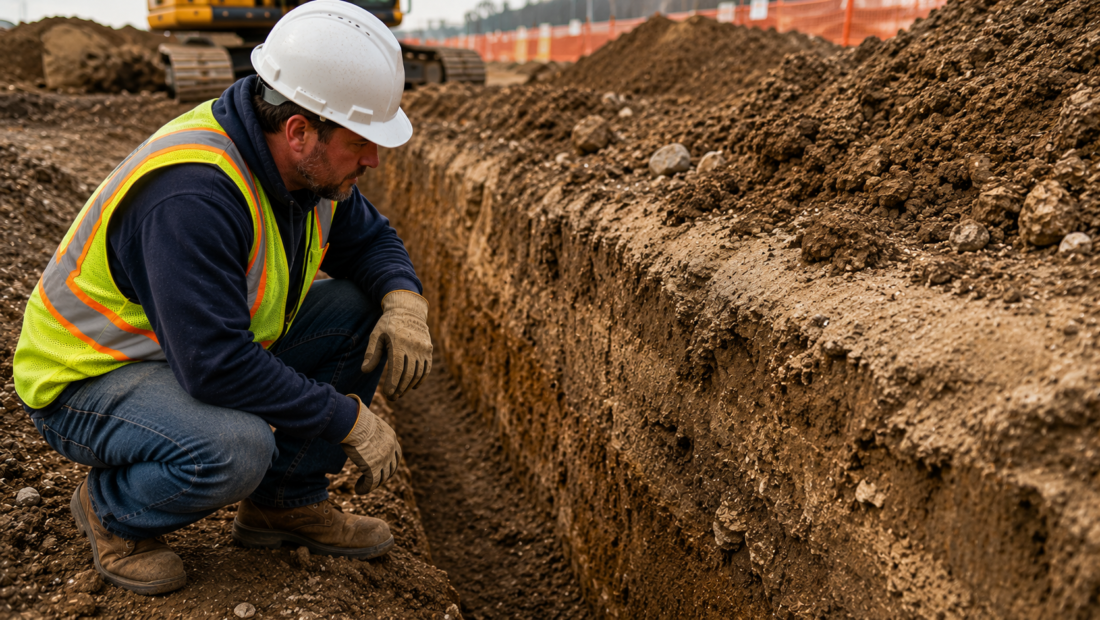
Forty construction workers die in trench cave-ins every year. OSHA tracks that number because most of those deaths were preventable. A trench doesn't have to be deep to kill someone. One cubic yard of soil can weigh as much as a car, and it gives no warning before it lets go.
Soil classification is the first call a competent person makes before anyone steps into a trench 5 feet deep or greater. Get it wrong and every decision after it, sloping, benching, shoring, is built on bad information.
OSHA 1926.652 requires a protective system for any trench 5 feet deep or more, unless the excavation is cut entirely through stable rock. Trenches under 5 feet still need protection if a competent person sees signs of a potential cave-in.
There's no gray area on who makes that call. A competent person is someone trained to recognize soil hazards and authorized to stop work and fix them on the spot. That's not a title you assign for the day. It's a trained role with real authority behind it.
OSHA groups soil and rock into four types. Know these cold, because the type you're in determines the slope angle, the shoring spec, and whether benching is even legal.
Stable rock is natural mineral material that can be cut with vertical sides and stay intact. In practice, it's rare. Blast or dig into it and you'll usually create fissures, which downgrades it to Type B.
Type A is the most stable soil classification. It's cohesive, with an unconfined compressive strength of 1.5 tons per square foot or greater. Clay, silty clay, sandy clay, and clay loam are typical examples. But Type A has disqualifiers: soil can't be classified Type A if it's fissured, previously disturbed, has water seeping through it, or sits near a vibration source like heavy traffic or a pile driver. A lot of soil that looks like Type A on paper gets bumped to B once you account for a nearby haul road.
Type B is cohesive soil with compressive strength between 0.5 and 1.5 tons per square foot, or granular cohesionless soil like angular gravel. It also catches any soil that would otherwise test as Type A but is fissured or vibration-affected, along with previously disturbed soil and dry unstable rock.
Type C is the least stable classification. Cohesive soil at 0.5 tons per square foot or less falls here, along with granular soils like sand, gravel, and loamy sand. Any soil with water freely seeping through it is automatically Type C, no matter what else it tests as. If your trench wall is sloughing steadily, you're looking at Type C.
A single trench can cut through more than one soil type. When that happens, classify the whole trench based on the weakest layer, not the average. OSHA's guidance is direct about this: a stable-looking top layer doesn't offset an unstable layer underneath.
Classification isn't a guess based on how the dirt looks. It requires both a visual and a manual test, and OSHA wants at least one of each.
Visual tests include watching the soil as it comes out of the ground, checking the spoil pile, and looking for cracks, layering, or water seeping from the trench face.
Manual tests are where you confirm what you saw. The three most common:
If you can't get a clean read, or conditions are borderline, default to the least stable classification. Treating questionable soil as Type C costs you some extra sloping or a wider trench box. Treating it as Type A when it's actually Type C costs a lot more.
Conditions change. A competent person has to reclassify at the start of every shift, and again any time conditions shift, after rain, a freeze-thaw cycle, or nearby excavation and vibration work.
Once you know the soil type, it sets the maximum allowable slope if you're sloping instead of shoring. These ratios and depth limits come from OSHA 1926 Subpart P, Appendix B, and apply to excavations 20 feet or less in depth:
That 34-degree slope for Type C isn't a small ask. An 8-foot-deep trench in Type C soil needs roughly 24 feet of extra width at the top to meet that ratio. That's the real cost of misjudging soil on the low side, more spoil, more excavation, and more trench footprint than the job may have room for.
Benching, cutting the wall into stepped horizontal levels instead of one continuous slope, is only legal in Type A and Type B soil. OSHA prohibits it outright in Type C, because granular soil won't hold a vertical face at any height, stepped or not.
Any excavation deeper than 20 feet falls outside the standard tabulated slope and shoring data entirely. At that depth, the protective system has to be designed and stamped by a registered professional engineer. There's no shortcut around that threshold regardless of soil type.
Most soil misclassification on real jobs isn't a competent person guessing wrong from scratch. It's soil that was fine an hour ago and isn't anymore. A dry trench wall that starts weeping after an upstream water main gets disturbed. A haul road that gets routed closer to the cut than it was during morning inspection. A Type A reading that never accounted for the vibration off the compactor running twenty feet away.
That's why the daily reclassification requirement isn't paperwork. It's the point where most cave-ins actually start, a crew working off yesterday's read on soil that changed overnight.
Mechanical trenching changes some of this calculus but not all of it. On a machine like the Street Trencher TCi 730, the operator runs the cut from the cab, not from inside the open trench, which cuts down on the amount of time anyone spends exposed to a cave-in during excavation. But once a crew goes in to lay pipe, place conduit, or inspect the cut, the same classification and protective system rules apply. The machine doesn't change what OSHA requires once a human is standing in the hole.
If you're not sure what you're standing in, treat it as Type C until a manual test proves otherwise. It costs you slope and space. Getting it wrong costs a lot more.
POSTED: June 30, 2026
TAGS: Trench Digging